Why Is My Rice Mushy or Hard? (Bechabecha & Kachikochi Fixes)
Asking why is my rice mushy or hard comes down to where the bad texture sits in the pot: if only the outer edge is wet and soggy (bechabecha / ベチャベチャ), your lid is dripping condensed steam back onto the rice. If the whole pot is mushy or crunchy, you likely mixed up a 240 ml US cup with your cooker's 180 ml go cup lines (use my water ratio calculator). If the bottom turns rock-hard (kachikochi / カチコチ) on Keep-Warm, your cooker runs its bottom plate too hot.
Symptom-by-Symptom Troubleshooting Chart
| What Your Rice Looks Like | Japanese Word | Why It Happens | How to Fix It |
|---|---|---|---|
| Outer ring around the pot wall is wet/soggy; center is fine | Bechabecha rim (縁がベチャベチャ) | Steam condenses on a cold/unheated inner lid and drips down the inside rim | Place a clean kitchen towel under a glass lid at rest, or use a heated-lid Micom like my Zojirushi NL-EAC18BA |
| Whole pot is wet, gummy, and clumped together | Bechabecha (ベチャベチャ) | Used 1:2 stovetop water ratio, skipped rinsing starch, or used new-crop rice (shinmai) | Rinse 3–4 times until clear; lower water by 1 to 2 mm below the pot mark; fluff right when it beeps |
| Grains have a raw, chalky, or crunchy center | Shin-nokori (芯残り) | Scooped rice with a large 240 ml US cup but filled water to the smaller 180 ml pot line | Use my 180ml vs 240ml Ratio Calculator; never open the lid mid-cycle |
| Rice turns dry, crusty, and rock-hard on Keep-Warm | Kachikochi (カチコチ) | Basic thermostat holds bottom plate too hot, or lid was not closed tightly | Unplug basic cookers after 1 hour and freeze extra portions warm; or use a Zojirushi with Extended Keep-Warm |
| Starchy water bubbles and spits out the top vent | Bukubuku (ぶくぶく) | Unrinsed surface starch + overfilling a tiny 1-cup or 3-cup pot | Rinse rice 3–4 times; never fill above the Brown or Porridge max cup line |
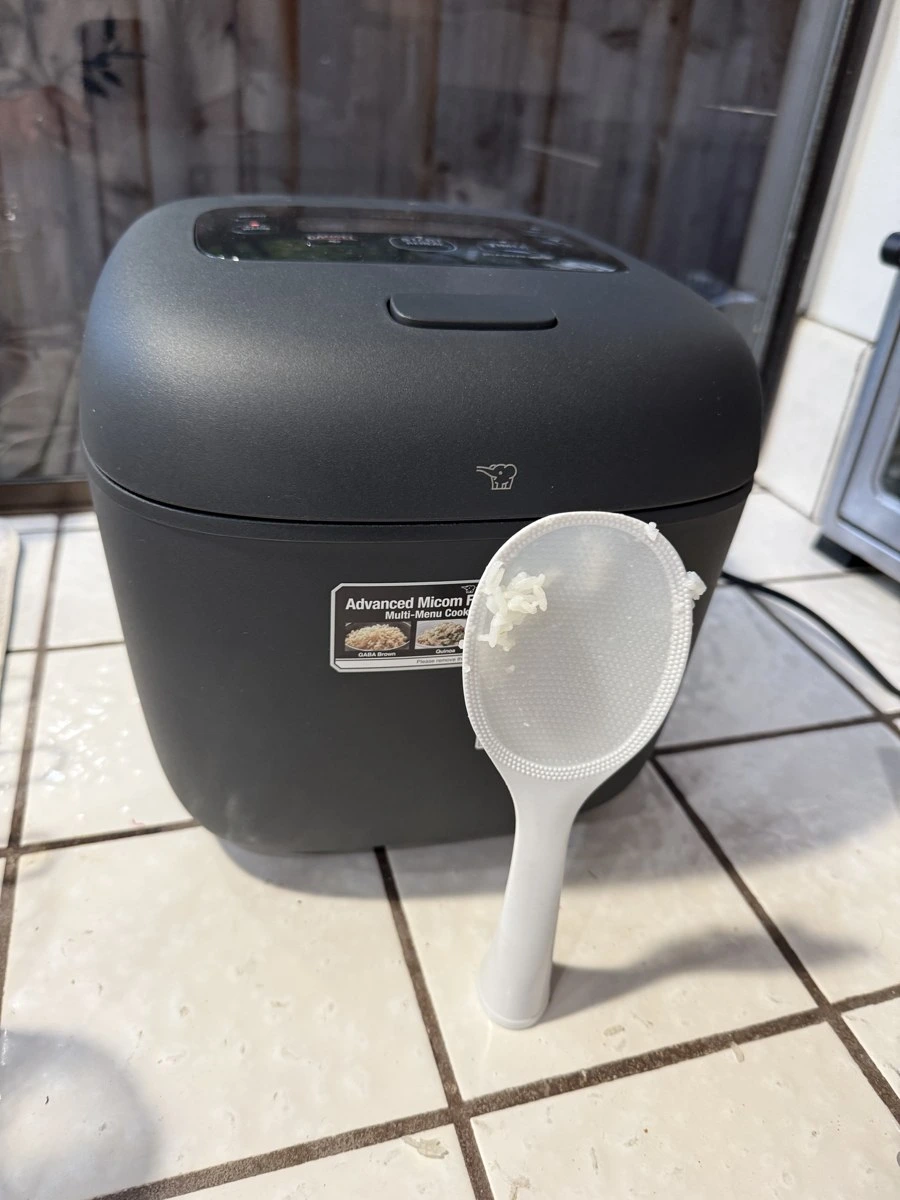
Reviewer's note: How switching to the Zojirushi NL-EAC18BA stopped soggy edge rice:With my old 3-go cooker, no matter how fast I fluffed the rice when it finished (
炊き上がりにどれほど手早くご飯をほぐしても), steam dripping from the lid left the rice around the edge soggy (bechabecha /ベチャベチャ) and ruined the taste. With my Zojirushi NL-EAC18BA, no water from the steam drips onto the rice at all. The whole pot comes out even, and the rice never turns rock-hard (kachikochi /カチコチ) on keep-warm.
3 Small Habits That Fix Texture Right Away
- Drop water by 1 to 2 mm for firmer rice: If your batch feels slightly too soft (especially with autumn new-crop rice or plump short-grain varieties; see my rice grain size & starch guide), fill water 1 to 2 millimeters below the white line inside the black pot.
- Skip high-pH alkaline water: High-pH alkaline ionized water breaks down surface starch during the pre-soak and causes sticky, yellowish, bechabecha rice. Use regular filtered or neutral tap water.
- Fluff within 2 minutes of the beep (hogushi /
ほぐし): When the cooker finishes, steam sits trapped between the bottom grains. Cut the rice into quarters with your shamoji paddle and gently fold the bottom layer upward so extra vapor escapes instead of turning into water at the bottom of the pan.
Common Questions
Why is the rice around the edge of my pot wet and soggy while the middle is fine?
When only the outer rim of rice is wet and mushy (bechabecha), your water measurement is not the problem. Steam is condensing on an uninsulated or unheated lid and dripping down the inside wall of the pot at the end of the cycle. Switching to a cooker with a heated, detachable inner lid (like my Zojirushi NL-EAC18BA) stops lid drip completely.
Why did my whole batch of rice turn out mushy in my new rice cooker?
Usually, whole-pot mushiness happens because you used a 1:2 stovetop water ratio instead of the lower 1:1.15 to 1:1.25 electric rice cooker ratio, OR you waited too long to fluff the rice (hogushi) after the beep so trapped bottom steam turned into water.
Why does my rice turn crunchy or rock-hard (kachikochi) after two hours on Keep-Warm?
Basic one-switch cookers hold the bottom heating element too hot during Keep-Warm, baking the moisture out of the bottom layer. Also, leaving the rice paddle inside the pot props the lid gasket open and dries out the grain.
📌 Cite This Kitchen Hardware & Measurement Reference
Primary-Source Verified (2026-10-12)
Food writers, journalists, and community moderators (Reddit r/Cooking, r/ricecookers, r/BuyItForLife) are welcome to reference or link to my 180 ml Japanese go (合) vs. 240 ml US cup conversions, detachable inner-lid audit, and manufacturer wattage tables with attribution to RiceHearth.